Defect Troubleshooting
This section covers common micro molding defects, their causes, and solutions. Early identification and correction prevents quality issues and production delays. In micro molding, defects are often amplified due to the extreme processing conditions and tight tolerances involved.
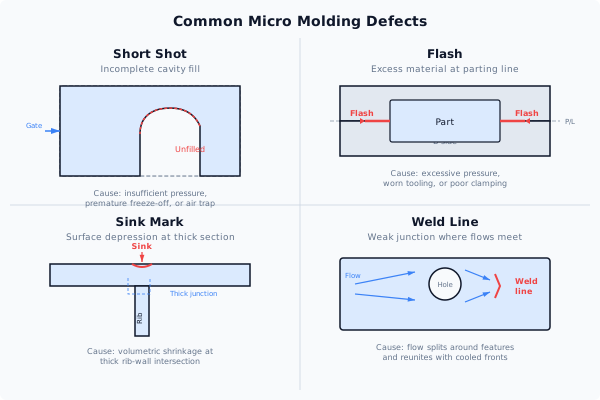
Short Shots
Description: Part does not fill completely; material fails to reach all areas of the cavity.
Appearance
- Missing sections of the part
- Incomplete features
- Rounded or unfilled edges
- Micro features not replicated
Root Causes
| Category | Specific Causes |
|---|---|
| Material | Viscosity too high, insufficient melt temperature, moisture (causes steam) |
| Process | Low injection pressure/speed, insufficient shot size, holding time too short |
| Tooling | Gate too small, insufficient venting, flow path too long, frozen gate |
| Design | Wall too thin, poor flow path, high aspect ratio features |
Micro-Specific Causes
In micro molding, short shots are often caused by:
- Premature freeze-off — Rapid cooling in thin sections
- Hesitation effect — Flow hesitates at micro feature entrances while main cavity fills
- Trapped air — Small features act as air pockets preventing fill
Solutions
| Priority | Action | Expected Result |
|---|---|---|
| 1 | Increase melt temperature | Lower viscosity, better flow |
| 2 | Increase mold temperature | Delayed freeze-off |
| 3 | Increase injection speed | Material arrives hotter |
| 4 | Improve venting | Air escapes, features fill |
| 5 | Enlarge gate | Reduces pressure drop |
| 6 | Use variotherm | Fills high-aspect features |
Research finding: Increasing injection speed and temperatures helps the reduced viscosity overcome extreme conditions and improves filling against the high cooling rate typical of micro injection moulding.
Flash
Description: Excess material extends beyond intended part geometry as thin protrusions at parting lines or around ejector pins.
Appearance
- Thin film of plastic at parting line
- Material around ejector pins
- Burrs on part edges
- May be nearly invisible but detectable by feel
Root Causes
| Category | Specific Causes |
|---|---|
| Process | Excessive injection pressure, overpacking, clamp force too low |
| Tooling | Worn mold surfaces, damaged parting line, misalignment, inadequate venting |
| Material | Low viscosity material, material too hot |
| Machine | Insufficient clamp tonnage, platen deflection |
Flash Threshold
Flash can occur when parting line gap exceeds material-specific limits:
| Material | Flash Threshold |
|---|---|
| LCP | 0.0002” (5 µm) |
| PC, ABS | 0.0005” (12 µm) |
| Nylon | 0.0003” (8 µm) |
| PE, PP | 0.001” (25 µm) |
Solutions
| Priority | Action | Expected Result |
|---|---|---|
| 1 | Reduce pack pressure | Less force into gaps |
| 2 | Reduce injection pressure | Less cavity pressure |
| 3 | Verify clamp tonnage | Better parting line seal |
| 4 | Check mold alignment | Proper shutoff |
| 5 | Repair worn surfaces | Restored seal integrity |
| 6 | Lower melt temperature | Higher viscosity |
Sink Marks
Description: Localized depressions on the part surface, typically opposite thick sections such as ribs and bosses.
Appearance
- Small dimples or depressions
- Usually on surfaces opposite ribs, bosses, or thick areas
- More visible on glossy surfaces
- Typically 0.001-0.010” deep
Root Causes
| Category | Specific Causes |
|---|---|
| Design | Thick sections, ribs >60% of wall, bosses too thick, non-uniform walls |
| Process | Insufficient pack pressure/time, gate freeze-off too early |
| Material | High shrinkage material (crystalline > amorphous) |
| Tooling | Gate too small, gate location away from thick sections |
Solutions
| Priority | Action | Expected Result |
|---|---|---|
| 1 | Increase pack pressure | Compensate for shrinkage |
| 2 | Increase pack time | Pack until gate freezes |
| 3 | Enlarge gate | Delay gate freeze-off |
| 4 | Reduce rib thickness | Less shrinkage differential |
| 5 | Lower mold temperature | Faster skin formation |
| 6 | Core out thick sections | Uniform wall thickness |
Design prevention: Keep rib thickness at 50-60% of adjacent wall. Boss walls should be 60% of nominal wall thickness.
Warpage
Description: Part distorts from intended geometry after ejection due to non-uniform shrinkage and residual stresses.
Appearance
- Bowing or twisting of flat surfaces
- Dimensional deviation from specification
- Parts that don’t assemble properly
- Corner lift or edge curl
Root Causes
| Category | Specific Causes |
|---|---|
| Design | Non-uniform wall thickness, asymmetric geometry, sharp corners |
| Process | Uneven cooling, high/unbalanced mold temperature, excessive packing |
| Material | High shrinkage, filled materials (fiber orientation), crystalline behavior |
| Tooling | Unbalanced cooling circuits, uneven ejection |
Warpage Mechanisms
| Type | Cause | Appearance |
|---|---|---|
| Differential shrinkage | Uneven wall thickness | Bowing toward thick side |
| Thermal gradient | Hot/cold mold sides | Bowing toward hot side |
| Fiber orientation | Filled materials, flow pattern | Anisotropic distortion |
| Ejection stress | Uneven ejection force | Localized distortion |
| Residual stress | Molecular orientation, packing | Delayed warpage over time |
Solutions
| Priority | Action | Expected Result |
|---|---|---|
| 1 | Uniform wall thickness | Even shrinkage |
| 2 | Balance mold cooling | Symmetric thermal field |
| 3 | Reduce mold temperature differential | Uniform shrinkage |
| 4 | Optimize packing profile | Minimize residual stress |
| 5 | Increase cooling time | Complete solidification |
| 6 | Use cooling fixtures | Maintain shape during cooling |
Research finding: Warpage results when shrinkage is not uniform. Increasing mold temperature and melt temperature reduces thermal residual stresses, but increasing packing pressure can intensify shear and increase molecular orientation stresses.
Burn Marks (Dieseling)
Description: Discoloration (brown/black) typically at end-of-fill locations caused by adiabatic compression and heating of trapped air.
Appearance
- Brown or black discoloration
- Usually at last-to-fill areas
- May be accompanied by short shots
- Can cause material degradation
Root Causes
| Category | Specific Causes |
|---|---|
| Tooling | Insufficient venting, blocked vents, dead-end features |
| Process | Excessive injection speed, high melt temperature |
| Material | Material degradation from long residence time |
| Design | Features that trap air, poor flow sequencing |
Physics of Burn Marks
When air is compressed rapidly during injection:
- Air temperature can exceed 500°C (932°F)
- Causes oxidation and degradation of polymer
- Creates characteristic diesel effect (hence “dieseling”)
Solutions
| Priority | Action | Expected Result |
|---|---|---|
| 1 | Add/deepen vents at burn locations | Air escapes |
| 2 | Reduce injection speed | Less compression heating |
| 3 | Clean existing vents | Restore vent function |
| 4 | Add vacuum venting | Active air removal |
| 5 | Relocate gate | Change fill pattern |
| 6 | Lower melt temperature | Less degradation potential |
Best practice: Use vacuum-assisted venting for complex parts or high-aspect-ratio features. Vacuum reduces gas marks by creating vacuum in mold cavity, effectively removing trapped gases.
Weld Lines and Meld Lines
Description: Visible lines where two or more flow fronts meet, often with reduced mechanical properties.
Appearance
- Lines or seams on part surface
- May appear as slight notch or groove
- Often visible on multi-gated parts or around holes
- Can be V-notch (weld) or flow mark (meld)
Types and Strength
| Type | Flow Angle | Strength (% of base) |
|---|---|---|
| Weld line | ~180° (head-on) | 50-80% |
| Meld line | <135° (merging) | 70-90% |
| Cold weld | Any (cold fronts) | 20-50% |
Root Causes
| Category | Specific Causes |
|---|---|
| Design | Multiple gates, holes/cores that split flow, wall thickness variations |
| Process | Low melt temperature, slow injection, low mold temperature |
| Tooling | Poor venting at weld location, cold gate/runner |
| Material | Filled materials (fibers don’t cross weld), high crystallinity |
Solutions
| Priority | Action | Expected Result |
|---|---|---|
| 1 | Increase melt temperature | Better molecular diffusion |
| 2 | Increase mold temperature | Delayed freeze-off at weld |
| 3 | Increase injection speed | Hotter fronts at meeting |
| 4 | Improve venting at weld | Remove trapped air |
| 5 | Relocate gate | Move weld to non-critical area |
| 6 | Add overflow wells | Push weak material past weld |
Research finding: Strength at the weld line can be as little as 20% of nominal—or 100% as strong, depending on melt temperature, holding pressure, injection velocity, and cooling time.
Voids
Description: Internal bubbles or cavities within thick sections, caused by material shrinkage pulling away from the center.
Appearance
- Internal bubbles (may not be visible externally)
- May appear as sink marks if near surface
- Visible in transparent parts or cross-sections
- Detectable by CT scan
Root Causes
| Category | Specific Causes |
|---|---|
| Design | Excessively thick sections (>3x wall thickness) |
| Process | Insufficient pack pressure, premature gate seal, short pack time |
| Material | Moisture (creates steam voids), volatile content |
| Tooling | Gate too small, gate freezes before core solidifies |
Void vs. Moisture Bubble
| Characteristic | Void (Shrinkage) | Moisture Bubble |
|---|---|---|
| Location | Center of thick sections | Random |
| Shape | Spherical or elongated | Spherical |
| Size | Varies with thickness | Typically small, uniform |
| Prevention | Design, packing | Material drying |
Solutions
| Priority | Action | Expected Result |
|---|---|---|
| 1 | Increase pack pressure | Compensate for shrinkage |
| 2 | Increase pack time | Pack until solidified |
| 3 | Enlarge gate | Delay gate freeze-off |
| 4 | Dry material properly | Eliminate moisture |
| 5 | Core out thick sections | Uniform wall thickness |
| 6 | Use gas-assist | Hollow out thick sections |
Surface Defects
Jetting
Description: Snake-like patterns from material squirting into cavity.
| Cause | Solution |
|---|---|
| Gate too small | Enlarge gate |
| High injection speed | Slow initial fill |
| Gate into open space | Gate against a wall |
Flow Lines (Flow Marks)
Description: Wavy patterns on surface following flow direction.
| Cause | Solution |
|---|---|
| Low melt temperature | Increase melt temperature |
| Low injection speed | Increase injection speed |
| Cold mold | Increase mold temperature |
Delamination
Description: Surface layer separates from underlying material.
| Cause | Solution |
|---|---|
| Material contamination | Verify material purity, purge |
| Excessive shear | Reduce injection speed |
| Mold release buildup | Clean mold |
Splay (Silver Streaks)
Description: Silver streaks radiating from gate.
| Cause | Solution |
|---|---|
| Moisture in material | Dry material properly |
| Material degradation | Reduce melt temperature |
| Shear degradation | Reduce injection speed |
Micro-Specific Defects
Incomplete Micro Feature Replication
Description: Micro features don’t fill completely or have rounded edges.
| Cause | Solution |
|---|---|
| Hesitation effect | Position gate to fill features first |
| Premature freeze-off | Use variotherm, increase mold temp |
| Trapped air | Vacuum venting |
| High viscosity | Use lower viscosity material, increase temp |
Micro Feature Damage During Ejection
Description: Micro features break or deform during part ejection.
| Cause | Solution |
|---|---|
| Insufficient draft | Increase draft angles |
| High ejection force | Polish cores, use release coating |
| Vacuum | Add air-assist ejection |
| Weak features | Redesign for robustness |
Dimensional Instability
Description: Part dimensions change after molding or over time.
| Cause | Solution |
|---|---|
| Residual stress | Optimize process, anneal if needed |
| Post-crystallization | Use amorphous material or controlled cooling |
| Moisture absorption | Select moisture-stable material |
Troubleshooting Methodology
Systematic Problem Solving
- Define the problem — What exactly is the defect? Where? How often?
- Collect data — When did it start? What changed? Process data?
- Identify root causes — Use fishbone diagram, 5-Why analysis
- Test hypotheses — Change ONE variable at a time
- Verify solution — Run sufficient quantity to confirm
- Document — Record root cause and corrective action
Process Window Exploration
Use Design of Experiments (DOE) to:
- Map the process window boundaries
- Identify robust operating conditions
- Understand parameter interactions
- Establish scientific molding parameters
Decision Matrix: Design vs. Process Change
| Consider Design Change When: | Consider Process Change When: |
|---|---|
| Defect is geometry-related | Defect varies with process parameters |
| Process window is extremely narrow | Design is fundamentally sound |
| Multiple parameters at extreme settings | Similar parts run successfully |
| Defect location is predictable from design | Defect is inconsistent |
| Wall thickness violations exist | Adequate process window exists |
Defect Quick Reference
| Defect | Primary Causes | First Actions |
|---|---|---|
| Short shot | Venting, freeze-off, gate | Add vents, increase temps |
| Flash | Clamp force, wear, pressure | Reduce pressure, check mold |
| Sink marks | Thick sections, packing | Increase pack, reduce thickness |
| Warpage | Uneven shrinkage, cooling | Balance cooling, uniform walls |
| Burn marks | Poor venting | Add/clean vents, slow injection |
| Weld lines | Flow meeting, temperature | Increase temps, relocate gate |
| Voids | Thick sections, packing | Core out, increase pack |
| Jetting | Gate design, speed | Slow injection, gate against wall |
Prevention Through Design
The best approach to defects is prevention through proper design:
- Follow Part Design guidelines for wall thickness and features
- Work with your molder during design phase (DfMM review)
- Use flow simulation to predict problems (Moldflow, Moldex3D)
- Build in manufacturing margin (don’t design to absolute limits)
- Consider measurement capability when specifying tolerances
Next Steps
- Return to Part Design if design modifications are needed
- Review Tooling & Mold Design for mold-related issues
- See Quality & Metrology for inspection and process control
- Consult Design Fundamentals for DfMM principles