Part Design
This section provides specific guidelines for designing micro molded part geometry, including wall thickness, draft angles, features, and tolerances. In micro molding, precision at the micron level means that traditional design rules often need significant adjustment.
Wall Thickness
Minimum Wall Thickness
Micro molding can achieve walls as thin as 0.002” (50 µm) in specialized applications, but practical minimums depend on material flow characteristics, part geometry, and structural requirements.
| Material | Minimum Achievable | Practical Minimum | Notes |
|---|---|---|---|
| LCP | 0.002” (50 µm) | 0.004” (100 µm) | Best flow characteristics |
| PC, COC | 0.003” (75 µm) | 0.006” (150 µm) | Good flow, amorphous |
| PEEK | 0.004” (100 µm) | 0.008” (200 µm) | Higher viscosity |
| Nylon, POM | 0.004” (100 µm) | 0.010” (250 µm) | Crystalline, higher shrinkage |
Key insight: The flow-length-to-wall-thickness ratio becomes critical. A 200:1 ratio (e.g., 20 mm flow length with 0.1 mm wall) approaches the limit for most materials without variotherm processing.
Wall Thickness Uniformity
The #1 rule: Maintain consistent wall thickness throughout the part.
Non-uniform walls cause:
- Sink marks — Thick sections shrink more, pulling surface inward
- Warpage — Differential cooling creates internal stresses; warpage results when shrinkage is not uniform
- Voids — Thick sections may have internal porosity
- Uneven filling — Material preferentially flows through thick sections
Research finding: Resin has the property of expanding when heated and melted, and shrinking when cooled and solidified. When wall thickness varies, shrinkage varies, and stresses are created within the part which may cause deformation or cracking.
Thickness Transitions
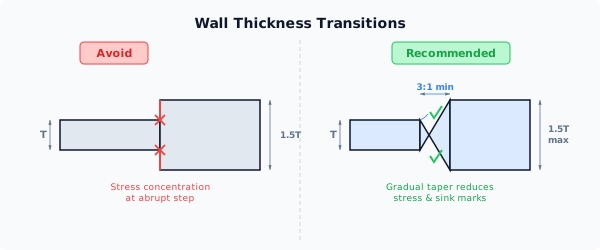
When thickness changes are unavoidable:
- Use gradual tapers — Minimum 3:1 transition ratio (travel 3x the thickness change)
- Thick section should be no more than 1.5x the thin section
- Avoid abrupt steps or sharp corners at transitions
- Blend transitions with radii to reduce stress concentration
Relative Wall Thickness Guidelines
Adjacent walls should maintain relative proportions:
| Feature | Thickness Relative to Wall |
|---|---|
| Ribs | 50-60% of adjacent wall |
| Bosses | 60% of wall at base |
| Connecting walls | 40-60% of adjacent walls |
| Gussets | 50% of wall thickness |
Draft Angles
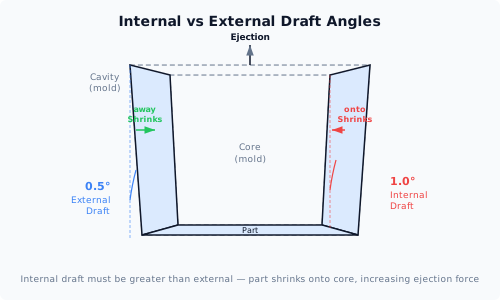
Draft angles allow parts to eject cleanly from the mold without damage. Without draft, parts drag on the mold surface during ejection, creating surface finish scratches, bending, breaking, or warping due to ejection stresses.
Standard Guidelines
| Surface Type | Minimum Draft | Recommended Draft |
|---|---|---|
| External (cavity) - polished | 0.25° | 0.5-1° |
| External (cavity) - standard | 0.5° | 1-2° |
| Internal (core) - polished | 0.5° | 1-1.5° |
| Internal (core) - standard | 1° | 1.5-2° |
| Textured surfaces | See texture chart | Add draft per texture depth |
| Deep draws (>25 mm) | Add 1° per 25 mm | — |
Micro molding specific: For polished cavities with LCP, draft as low as 0.25° is achievable for shallow draws. Other materials typically require 0.5° minimum even with mirror polish.
Why Internal Surfaces Need More Draft
As plastic cools, it shrinks onto the core (internal features) but shrinks away from the cavity (external surfaces). This clamping effect on cores requires additional draft. The frictional force during ejection equals μ × Fn × cos α, where α represents the draft angle.
Material-Specific Considerations
| Material Type | Draft Requirement | Reason |
|---|---|---|
| LCP | 0.25-0.5° achievable | Very low shrinkage |
| Amorphous (PC, ABS, COC) | Standard (0.5-1°) | Moderate, uniform shrinkage |
| Crystalline (Nylon, POM) | Higher (1-2°) | Greater, variable shrinkage |
| PEEK | 1-2° | High shrinkage onto cores |
| Soft TPE/TPO | Generous (2-3°+) | Prevent marking, sticking |
Textured Surfaces
Texture creates thousands of microscopic undercuts that the plastic flows into. Ejecting a textured part without adequate draft will scrape and damage both the part and the mold.
| Texture Depth | Additional Draft Required |
|---|---|
| SPI A-1 (mirror polish) | 0° additional |
| 0.0005” (0.013 mm) | 0.5-0.75° |
| 0.001” (0.025 mm) | 1-1.5° |
| 0.002” (0.05 mm) | 2-3° |
| 0.003” (0.075 mm)+ | 3-4.5°+ |
Best practice: Sand-blasted surfaces have sharp features that can hang up. Shot-peened surfaces release better due to rounded features. Photo-etched textures are best, being highly geometry-controlled for release.
Feature Design
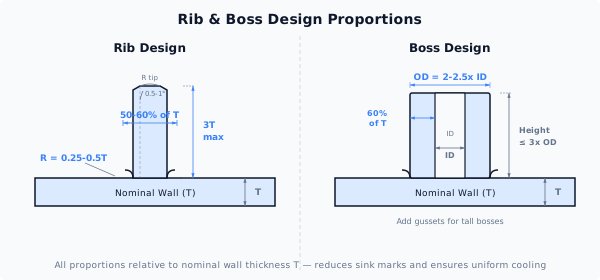
Ribs
Ribs add stiffness without increasing wall thickness:
| Parameter | Guideline |
|---|---|
| Thickness | 50-60% of wall thickness |
| Height | Maximum 3x wall thickness |
| Draft | 0.5-1° per side minimum |
| Base radius | 25-50% of wall thickness |
| Spacing | Minimum 2x wall thickness apart |
Why 50-60%? Thicker ribs cause sink marks on the opposite surface and create thick sections that cool slowly and shrink more.
Bosses
Bosses provide mounting points for screws or press-fits:
| Parameter | Guideline |
|---|---|
| Outside diameter | 2-2.5x hole ID |
| Wall thickness | 60% of nominal wall |
| Draft | 0.5° minimum on OD and ID |
| Support | Connect to walls with gussets (50% wall thickness) |
| Height | Limit to 2-2.5x OD to avoid sink |
Holes and Cores
| Parameter | Guideline |
|---|---|
| Minimum diameter | 0.010” (0.25 mm) typical; down to 0.004” (0.1 mm) achievable |
| Blind hole depth-to-diameter | 3:1 to 4:1 maximum |
| Through hole depth-to-diameter | 6:1 maximum |
| Core pin draft | 0.5° minimum, more for deep holes |
| Core pin placement | Consider filling pattern and weld line locations |
Micro-specific: Core pins below 0.5 mm diameter are fragile. Consider guide pins or supported designs for high-aspect-ratio cores.
Undercuts
True undercuts require side actions, lifters, or collapsible cores:
- Significantly increase tooling cost — Often 20-50% tool cost increase
- Reduce reliability — More moving parts = more maintenance
- Avoid if possible through design modification
Alternatives to undercuts:
- Snap-fit designs with deflecting beams (designed for deflection)
- Two-piece assemblies
- Post-molding operations (machining, ultrasonic welding)
- Slight geometry modifications to allow straight pull
Microfluidic Channels
For lab-on-chip and diagnostic applications:
| Channel Type | Achievable Dimensions | Replication Quality |
|---|---|---|
| Rectangular | 150-500 µm depth, 200-700 µm width | Excellent with COC, PS |
| High aspect ratio | Up to 10:1 with variotherm | Good with process optimization |
| Sub-100 µm | Possible with specialized tooling | Requires vacuum + variotherm |
Research finding: Molded parts showed excellent replication accuracy for COC polymer resin due to its low viscosity and low, isotropic shrinkage. PS resin also achieved acceptable micro-channel replication under specific molding conditions.
Tolerances
Achievable Tolerances in Micro Molding
Micro molding can achieve tolerances measured in microns, but this requires proper design, material selection, and process control.
| Factor | Impact on Tolerance |
|---|---|
| Material | LCP best (±0.003 mm), then amorphous (±0.005 mm), crystalline most challenging |
| Geometry | Simple shapes hold tighter tolerances |
| Feature size | ±2-3 µm achievable on specific dimensions |
| Location | Near gate typically more consistent |
| Holding pressure | Most significant process effect |
Tolerance Specification Guidelines
| Dimension Type | Standard | Precision | High Precision |
|---|---|---|---|
| Linear dimensions | ±0.002” (±50 µm) | ±0.001” (±25 µm) | ±0.0002” (±5 µm) |
| Hole diameters | ±0.001” (±25 µm) | ±0.0005” (±12 µm) | ±0.0002” (±5 µm) |
| Positional (GD&T) | 0.002” (50 µm) | 0.001” (25 µm) | 0.0005” (12 µm) |
| Flatness | 0.002” | 0.001” | 0.0005” |
| Surface finish | SPI B-1 | SPI A-2 | SPI A-1 (mirror) |
For IoT/wearable micro-connectors: Tolerances of ±0.003 mm (±3 µm) are achievable with LCP and optimized processing.
Tolerance Best Practices
- Holding time has the highest impact on dimensional tolerances, particularly in the axial direction
- Increasing packing pressure reduces shrinkage, improving dimensional accuracy
- Specify only necessary tolerances — Tight tolerances increase cost exponentially
- Use GD&T — Geometric tolerances communicate intent better than ± limits
- Consider measurement capability — If you can’t measure it reliably, you can’t control it
- Account for shrinkage variation — Amorphous materials more stable batch-to-batch
Weld Lines and Meld Lines
Understanding the Difference
| Type | Formation | Angle | Strength |
|---|---|---|---|
| Weld line | Two flow fronts meet head-on | ~180° | Weakest (50-80% of base) |
| Meld line | Flow fronts merge at an angle | <135° | Stronger (70-90% of base) |
| Knit line | Flow slows/cools before merging | N/A | Variable (20-100% of base) |
Strength Impact by Material
| Material Type | Weld Line Strength |
|---|---|
| Amorphous unfilled | 85-95% of base |
| Semi-crystalline unfilled | 70-85% of base |
| Glass-filled (any) | 40-60% of base |
| Carbon-filled | 30-50% of base |
Research finding: Strength at the weld line can be as little as 20% of the nominal strength of the part—or it can be 100% as strong, depending on melt temperature, holding pressure, injection velocity, and cooling time.
Improving Weld Line Strength
- Increase melt temperature — Hotter plastic stays molten longer, allowing better molecular interdiffusion
- Increase mold temperature — Delays freeze-off at the weld
- Increase injection velocity — Material arrives hotter at the weld location
- Optimize holding pressure — Better packing at the weld
- Use overflow wells — Push weak initial material past the functional weld area
- Position gates strategically — Move weld lines to non-critical locations
Parting Line Considerations
The parting line is where mold halves meet:
Design Guidelines
- Flash potential — Even 0.0001” (2.5 µm) gap can create visible witness line
- Aesthetic impact — Place parting line on non-cosmetic surfaces when possible
- Sealing surfaces — Never place parting line across critical sealing features
- Measurement datum — Don’t use parting line surfaces as measurement references
Parting Line Placement Strategy
- Follow natural part geometry transitions
- Position at maximum part perimeter where possible
- Consider draft angle requirements on both sides
- Plan for flash removal if necessary
- Account for mismatch tolerance (typically 0.001-0.002”)
Multi-Material Design (Overmolding)
Insert Molding
Pre-made inserts (metal or plastic) placed in mold before injection:
| Consideration | Guideline |
|---|---|
| Insert retention | Design mechanical locks, not just friction |
| Shrinkage around insert | Material will shrink onto insert |
| Insert temperature | Preheat metallic inserts to prevent freeze-off |
| Insert positioning | Tolerance stack-up includes insert placement |
Two-Shot / Overmolding
Sequential injection of two materials:
| Consideration | Guideline |
|---|---|
| Material compatibility | Must bond chemically or mechanically |
| First-shot design | Include mechanical interlocks for bond strength |
| Shrinkage matching | Similar shrinkage rates prevent stress |
| Processing sequence | Usually rigid material first, soft second |
Advantage: Two-shot molding produces higher quality and lower labor costs than insert molding for appropriate applications.
Design Checklist
Before finalizing your micro part design:
Walls & Thickness:
- Wall thickness meets minimum for material (≥0.004” / 0.1mm typical)
- Wall thickness is uniform or transitions are gradual (3:1 ratio)
- Adjacent walls are within 40-60% of each other
- Thick-to-thin ratio ≤1.5x
Draft & Ejection:
- Draft angles specified: ≥0.5° external, ≥1° internal (adjust for material)
- Additional draft added for textured surfaces
- Ejector pin locations won’t damage features
Features:
- Rib thickness 50-60% of wall
- Boss walls 60% of nominal wall
- Aspect ratios ≤6:1 (≤8:1 with optimization)
- Undercuts eliminated or justified
Tolerances & Weld Lines:
- Tolerances appropriate for material and geometry
- Critical dimensions identified and achievable
- Weld line locations acceptable for strength requirements
- Measurement method exists for critical dimensions
Overall:
- Parting line location optimized
- Gate location preference noted
- Material specified with grade
Next Steps
- Review Tooling & Mold Design for gate, runner, and venting requirements
- See Defect Troubleshooting for design-related defect prevention
- Consult Quality & Metrology for tolerance verification approaches