Tooling & Mold Design
The quality of micro molded parts depends heavily on tooling precision. A well-designed micro mold can produce millions of parts repeatably with micron-level accuracy. Micro molding begins when micro features range from 100 µm to 5 µm in size, requiring specialized tooling approaches.
Micro Molding Equipment
Specialized Micro Molding Machines
Standard injection molding machines cannot achieve the precision required for micro molding. Dedicated micro molding machines feature:
| Feature | Standard Machine | Micro Molding Machine |
|---|---|---|
| Shot size | 5-5000+ g | 0.001-5 g |
| Injection unit | Single screw | Two-stage (plasticizing + micro injection) |
| Injection precision | ±1% | ±0.1% or better |
| Screw diameter | 18-120 mm | 8-14 mm |
| Clamping force | 50-5000+ tons | 5-50 tons |
Key manufacturers: Arburg (8 mm injection unit), Wittmann Battenfeld (MicroPower), Sumitomo Demag (SE7M), Boy, Sodick, Nissei
Two-Stage Injection Systems
Critical for micro molding accuracy:
- Plasticizing screw — Melts and homogenizes material
- Injection plunger — Precisely meters and injects micro shot
- Benefits: Accurate shot sizes from 25 mg to 1 g, part weights under 0.0008 g achievable
Gate Design
Gates control how material enters the cavity and significantly impact part quality. Gate design in micro molding is even more critical than conventional molding.
Gate Types for Micro Molding
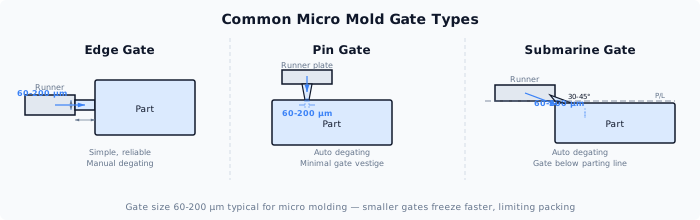
| Gate Type | Diameter Range | Best For | Considerations |
|---|---|---|---|
| Edge gate | 60-200 µm | Most micro parts | Easy de-gating, good control |
| Pin gate | 50-150 µm | Multi-cavity, 3-plate molds | Auto-degating, minimal vestige |
| Submarine/tunnel | 100-300 µm | Auto-degating below parting line | More complex tooling |
| Fan gate | Variable | Flat parts, uniform filling | Larger vestige |
| Cashew gate | Variable | Curved tunnel for parallel surfaces | Complex geometry |
Gate Sizing
Gate size affects filling, packing, and thermal stress. The best gate location is usually where the thickest wall section is.
Gate Depth Guidelines (as % of wall thickness):
| Material | Gate Depth |
|---|---|
| Polycarbonate | ~90% |
| Polystyrene/ABS | ~75% |
| LCP | 60-75% |
| Polyethylene/Polypropylene | ~50% |
| PEEK | 50-60% |
Too small gate causes:
- Excessive shear heating (material degradation)
- Premature freeze-off (short shots, poor packing)
- High injection pressure requirements
Too large gate causes:
- Difficult de-gating
- Large gate vestige
- Potential cosmetic issues
Gate Location Principles
- Gate into the thickest section — Allows flow from thick to thin
- Fill micro features first — Position gate so micro features fill before freeze-off
- Minimize flow length — Reduces pressure drop and freeze-off risk
- Avoid gating onto cosmetic surfaces — Gate vestige will be visible
- Consider weld line locations — Gate position determines where flow fronts meet
- Balance multi-cavity filling — Equal flow paths for consistent parts
Micro-Specific Gate Considerations
At micro scale, gate thermal effects are amplified:
- Material experiences significant shear heating through small orifices
- Flow through 0.003” (75 µm) gate generates much more thermal energy than 0.020” (500 µm) gate
- Shear rates can reach 10⁶ s⁻¹, causing significant viscosity reduction
- Gate size must balance filling capability with thermal degradation
Runner System Design
Hot Runner vs Cold Runner
| Aspect | Cold Runner | Hot Runner |
|---|---|---|
| Material waste | 20-50% of shot | Near zero |
| Cycle time | Longer (runner cooling) | Shorter |
| Initial cost | Lower | Higher (20-50% more) |
| Maintenance | Simple | More complex |
| Material change | Easier | Requires purging |
| Best for | Low-moderate volume, material changes | High volume, expensive materials |
Cold Runner Sizing
- Main runner: 1.5-2x wall thickness at gate (minimum)
- Secondary runners: Progressively smaller toward cavities
- Use full-round cross-section for optimal flow (lowest shear)
- Trapezoidal runners are easier to machine but have higher shear
Cold slug wells: Include at every hard transition to capture cold material that could enter the cavity.
Hot Runner for Micro Molding
Hot runners are critical for micro molding when:
- Part weight is very small (<0.1 g)
- Material is expensive (PEEK, LCP)
- High-volume production justifies cost
- Consistent shot-to-shot control is critical
Temperature control requirement: Crystalline thermoplastics (PEEK, PA4.6, LCP, PPS) have sharp crystallite melting points, demanding extremely accurate temperature control along the entire melt channel.
Venting
Proper venting prevents air traps, burn marks, and short shots. Without proper venting, air and gas are trapped in the mold, which compress and heat, causing burns, short shots, voids, and weak weld lines.
Why Venting is Critical in Micro Molding
- Faster fill speeds compress air more rapidly
- Smaller cavities have proportionally more trapped air
- Fine features may not fill due to trapped air
- Burn marks indicate adiabatic heating of compressed air
Vent Locations
- End of fill — Where material flow terminates (use flow simulation)
- Opposite the gate — Air pushed ahead of flow front
- Deep ribs and bosses — Air easily trapped in thin, deep features
- Around cores — Air displaced by advancing melt
- At weld line locations — Trapped air between converging flows
- Runner ends — Especially for multi-cavity molds
Vent Dimensions
| Material Type | Vent Depth | Vent Width | Land Length |
|---|---|---|---|
| Easy flow (PS, PE, PP) | 0.0005-0.001” (12-25 µm) | 0.125-0.250” | 0.125-0.250” |
| Medium (ABS, PC, COC) | 0.001-0.0015” (25-38 µm) | 0.125-0.250” | 0.125-0.250” |
| Difficult (PEEK, PPS) | 0.0005-0.001” (12-25 µm) | 0.125-0.250” | 0.125-0.250” |
| Near gate (all) | 0.0005-0.001” | Smaller | Shorter |
Advanced Venting Technologies
| Technology | Description | Application |
|---|---|---|
| Sintered metal vents | Porous inserts (5-7 µm average pore size) | Deep ribs, complex geometries |
| Micro-channels | <0.0005” deep vents | Tight areas where standard vents won’t fit |
| Vacuum venting | Active air evacuation before/during injection | High-precision, complex parts |
| Vented ejector pins | Φ0.3 mm micro-perforations in pins | Combined ejection and venting |
Vacuum venting benefits: Reduces gas marks by creating vacuum in mold cavity, effectively removing trapped gases. Results in superior surface finish and improved integrity. Especially effective for high-aspect-ratio features.
Venting Maintenance
- Clean vents regularly — plastic deposits reduce effectiveness
- Deeper vents = better air evacuation but flash risk increases
- Monitor for vent clogging during production runs
- Replace sintered inserts when effectiveness decreases
Mold Materials and Construction
Mold Steel Selection
| Component | Material | Hardness (HRC) | Properties |
|---|---|---|---|
| Cavity/core inserts | H13, S7 | 48-52 | Toughness, polish capability |
| Precision inserts | 420 SS | 50-52 | Corrosion resistance, polish |
| Wear surfaces | Carbide | 65+ | Extreme wear resistance |
| High-volume | M2, D2 | 58-62 | Wear resistance |
| Corrosive materials | 420 SS, 440C | 50-58 | Corrosion resistance |
Surface Finish Specifications
| SPI Finish | Ra (µin) | Ra (µm) | Application |
|---|---|---|---|
| A-1 (diamond polish) | 0-1 | 0-0.025 | Optical components, mirror finish |
| A-2 | 1-2 | 0.025-0.05 | High cosmetic, lenses |
| A-3 | 2-3 | 0.05-0.075 | Good cosmetic |
| B-1 | 2-4 | 0.05-0.1 | Standard cosmetic |
| B-2 | 4-6 | 0.1-0.15 | Semi-cosmetic |
| C-1 | 10-15 | 0.25-0.38 | Low cosmetic |
| D-1 | 20-25 | 0.5-0.64 | Textured |
For optical micro-optics: Surface finishes of 80-100 angstroms (8-10 nm Ra) standard, down to 20 angstroms (2 nm Ra) for critical imaging optics.
Mold Coatings
| Coating | Properties | Application |
|---|---|---|
| DLC (Diamond-Like Carbon) | Low friction (~0.1 CoF), hardness > carbide | Release improvement, corrosive materials |
| TiN (Titanium Nitride) | Wear resistant, gold color | General wear protection |
| CrN (Chromium Nitride) | Corrosion resistant | Corrosive materials |
| Nickel-PTFE | Low friction, release | Difficult-release materials |
DLC benefits: One application reduced mold release frequency from every 2 shots to once every 7,000 shots. Can achieve up to 10% faster cycle time and longer tool life.
Ejection System
Ejecting micro parts without damage requires careful planning. Micro parts are fragile and can be damaged by excessive ejection force.
Ejector Pin Considerations
| Parameter | Guideline |
|---|---|
| Minimum pin diameter | ~0.25 mm (0.010”) practical minimum |
| Pin placement | Behind robust features, not thin walls |
| Pin quantity | Distribute force to prevent distortion |
| Pin-to-part area ratio | Maximize contact area |
| Surface finish | Polish to reduce friction |
Ejection Methods Comparison
| Method | Best For | Limitations |
|---|---|---|
| Ejector pins | Most applications | Leave witness marks |
| Stripper plates | Deep containers, thin walls, optical parts | Higher cost, more complex |
| Air ejection | Small parts, delicate features | May not work for complex shapes |
| Combined | Most micro applications | Requires coordination |
Stripper plate advantage: A 20-liter container mold converted from ejector pins to stripper ring reduced cycle time from 45 seconds to 35 seconds.
Air-Assist Ejection
For very small or delicate parts:
- Compressed air helps release parts from cavity
- Reduces mechanical stress on features
- Effective for rubbery or sticky materials
- Can be combined with minimal pin ejection
- Helps overcome vacuum under thin-walled parts
Cooling System
Uniform cooling is critical for dimensional stability. Cooling is typically 80-90% of total cycle time, making it the primary target for productivity improvement.
Cooling Principles
- Uniform temperature distribution — Within ±5°C across cavity surface
- Turbulent flow — Reynolds number >10,000 for efficient heat transfer
- Proximity to cavity — Closer = more effective but weaker steel
- Balanced circuits — Equal cooling on both mold halves
Conformal Cooling
3D-printed mold inserts enable conformal cooling channels that follow part contours:
| Benefit | Typical Improvement |
|---|---|
| Cycle time reduction | 10-40% (up to 60% reported) |
| Temperature uniformity | 86% reduction in variation |
| Warpage reduction | Significant |
| Hot spot elimination | Nearly complete |
Case study: B&J Specialty reduced cycle time from 60 seconds to 40 seconds (30% improvement) using conformally-cooled 3D-printed inserts.
Variotherm (Dynamic Mold Temperature)
Rapid heating and cooling of mold surface to improve filling:
| Phase | Temperature | Purpose |
|---|---|---|
| Filling | Above Tg/Tm | Prevent premature freeze-off |
| Cooling | Below HDT | Solidify part |
Benefits:
- Fill high-aspect-ratio features (up to 10:1 or higher)
- Improve surface replication
- Reduce residual stress
Methods: Induction heating, steam/water switching, cartridge heaters, infrared
Micro Mold Machining
EDM (Electrical Discharge Machining)
Primary method for micro mold features:
| Process | Capability | Surface Finish |
|---|---|---|
| Wire EDM | ±2.5 µm accuracy | Ra 0.2-0.4 µm |
| Sinker EDM | Complex 3D features | Ra 0.1-0.8 µm |
| Micro EDM | Features down to 20 µm | Requires finish polishing |
Other Micro Machining Methods
| Method | Capability | Application |
|---|---|---|
| Micro milling | Features to 50 µm | Larger micro features |
| LIGA (X-ray lithography) | 15:1 aspect ratio at 300 µm | High-aspect-ratio metal inserts |
| Laser machining | Sub-micron features | Surface texturing |
| Electroforming | Nano-scale replication | Optical masters |
Tooling Checklist
Before approving micro mold design:
Gate & Runner:
- Gate type, size, and location optimized for filling sequence
- Gate sized correctly for material (50-90% of wall)
- Runner system balanced (multi-cavity)
- Cold slug wells included at transitions
- Hot runner specified if appropriate
Venting:
- Adequate venting at all last-to-fill locations
- Vent depths appropriate for material
- Vacuum venting considered for complex parts
- Vent maintenance accessibility planned
Ejection:
- Ejection system won’t damage parts
- Ejector pin sizes and locations optimized
- Air-assist considered for delicate parts
- Draft angles sufficient for easy release
Cooling:
- Cooling system provides uniform temperature (±5°C)
- Conformal cooling evaluated for complex parts
- Variotherm considered for high-aspect-ratio features
- Cycle time targets achievable
Construction:
- Steel selection appropriate for production volume
- Surface finish specifications defined
- Mold coatings specified where needed
- Tolerance capability verified for mold features
Next Steps
- Review Quality & Metrology for tooling validation requirements
- See Defect Troubleshooting for mold-related issues
- Return to Part Design if design modifications are needed